The Early Years of Rhythm and Blues: Photographs by Benny Joseph from the Documentary Arts Collection
About
The photographs in this exhibition are part of an important recent donation to the International Center of Photography (ICP) by Documentary Arts, founded by Alan Govenar in 1985 to present new perspectives on historical issues and diverse cultures. The Early Years of Rhythm and Blues was the first traveling exhibition organized by Documentary Arts and led to the growth of the Texas African American Photography Archive, founded in 1995 by Govenar and Kaleta Doolin.
In curating this exhibition, Govenar reviewed approximately ten thousand negatives made by Benny Joseph over the course of his forty-year career. When Govenar met Joseph in 1983 he had already closed his studio at 2305 Blodgett Street in Houston and was retired. There were no vintage prints, but his negatives were filed in storage. The prints in this exhibition were made by Ron Evans, who worked with Govenar and Joseph to generate Silver Gelatin prints which reflect the original intent of the photographer.
Benny Joseph's interest in photography began in 1940 at age sixteen while he was a high school student in Houston. When he was discharged from the Army in 1945 and returned to his home in Texas, he enrolled in a two-year program at Teal's School of Photography. A.C. Teal was a prominent black portrait photographer who prepared his students for careers in commercial photography. Like his contemporaries, Joseph recalls that he had to 'do it all' to make a living as a photographer — portraits, snapshots, news, advertising, churches, parades, politicians, social groups, dances, and musicians. The mainstay of Joseph's business throughout his career was studio portraiture, although he also worked for the NAACP, KCOH radio, the Buffalo Booking Agency, and Duke-Peacock Records, one of the first and most successful black-owned recording companies in the United States.
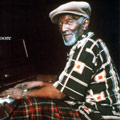
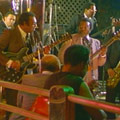
The photographs in this exhibition were made by Benny Joseph with a Speedgraphic camera and focus on the early years of rhythm and blues music in Houston in the context of the civil rights movement. Featured are photographs of some of the most noted performers of the day, such as BB King, Junior Parker, Della Reese, Mahalia Jackson, Albert Collins, Joe Hinton, and Little Frankie Lee. In addition, there are photographs of civil rights leaders Martin Luther King Jr. and Thurgood Marshall, as well as street scenes and the everyday life and community of the musicians and their audience, including KCOH radio broadcasts, record promotions, teen hops, and dances in the legendary ballrooms of the 1950s and 1960s.
The significance of the exhibition is far-reaching and addresses issues relevant to the study of photography, art history, folklore, music, and African-American life and culture.
Read more: http://www.icp.org/files/bennyjoseph_press-release15_10.2.pdf
The Early Years of Rhythm and Blues
Exhibition History, 1989-2016
| 1/14/89 - 4/16/89 | Tyler Museum of Art Tyler, Texas |
| 5/12/89 - 6/25/89 | Barker Texas History Center University of Texas Austin, Texas |
| 6/4/89 - 6/25/89 | Carver Museum Austin, Texas |
| 7/8/89 - 8/13/89 | University Museum University of Mississippi Oxford, Mississippi |
| 9/1/89 - 9/24/89 | The Gallery Hughes-Trigg Student Center Southern Methodist University Dallas, Texas |
| 3/30/90 - 5/11/90 | African American Heritage Museum Houston, Texas |
| 10/3/91 ‑ 10/24/91 | Watkins Center Kansas City, Missouri |
| 11/4/91 ‑ 11/25/91 | University of Arkansas Fayetteville, Arkansas |
| 1/1/92 ‑ 1/22/92 | Starr Commonwealth School Albion, Michigan |
| 2/1/92 ‑ 2/22/92 | College Student Activities South East Campus Tulsa, Oklahoma |
| 2/1/92 - 6/30/92 | Schomburg Center for Research in Black Culture The New York Public Library New York, New York |
| 3/5/92 ‑ 3/26/92 | Northern Essex Community College Bentley Library Haverhill, Massachusetts |
| 4/6/92 ‑ 4/27/92 | Adler Center Libertyville, Illinois |
| 5/8/92 ‑ 5/29/92 | Center for Cultural Arts Gadsden, Alabama |
| 6/9/92 ‑ 7/10/92 | Quad City Arts Rock Island, Illinois |
| 7/20/92 ‑ 8/21/92 | Parkersburg Art Center Parkersburg, West Virginia |
| 9/1/92 ‑ 9/23/92 | Macky Gallery University of Colorado Boulder, Colorado |
| 10/3/92 ‑ 10/24/92 | Highland Community College Highland, Kansas |
| 11/4/92 ‑ 11/30/92 | Longmont Museum Longmont, Colorado |
| 12/15/92 ‑ 1/15/93 | Bassett Arts Council Bassett, Nebraska |
| 1/28/93 ‑ 4/27/93 | Institute of Texan Culture San Antonio, Texas |
| 5/8/93 ‑ 7/9/93 | Roswell Museum and Art Center Roswell, New Mexico |
| 9/1/93 - 9/29/93 | Cable Access of Dallas Dallas, Texas |
| 2/1/94 - 2/21/94 | Irving Arts Center, Main Gallery Irving, Texas |
| 1/25/96 - 2/24/96 | Hertzberg Museum San Antonio, Texas |
| 10/18/15 - 1/10/16 | The Early Years of Rhythm and Blues: Photography by Benny Joseph from the Documentary Arts Collection International Center of Photography Mana Contemporary Jersey City, New Jersey |